
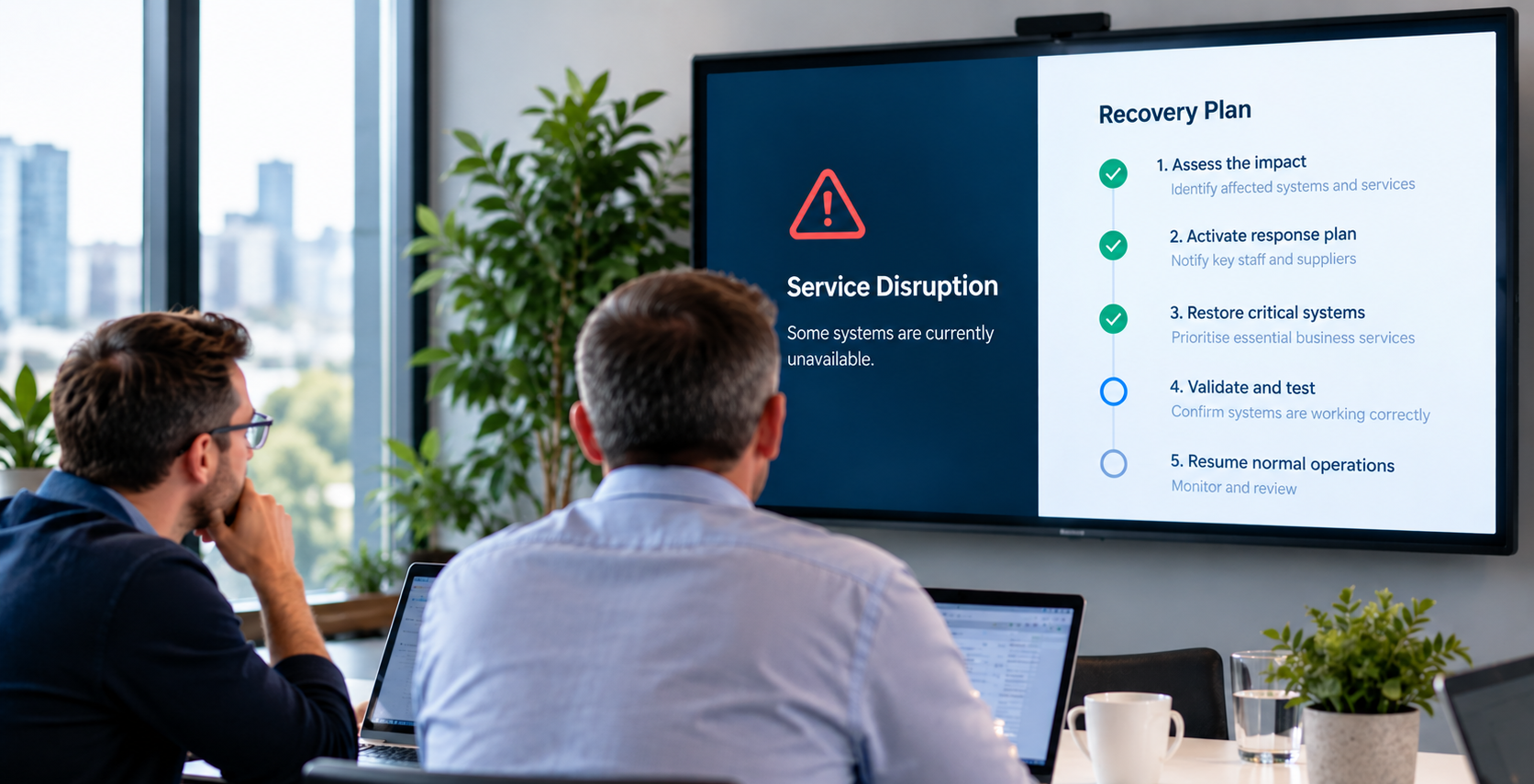
Business Continuity vs Disaster Recovery: What’s the Difference?
Business continuity and disaster recovery are closely related, but they are not the same thing. Both help organisations prepare for disruption, reduce downtime and recover when something goes wrong.
Business continuity focuses on how your organisation continues operating during and after a disruption. Disaster recovery focuses more specifically on restoring the technology, systems and data required to support those operations.
A cyber incident, server failure, Internet outage, power disruption, data loss or loss of access to an office can affect more than IT. Staff, communications, suppliers and critical business processes may all be impacted.
Understanding the difference helps organisations develop practical plans that address both the immediate business impact and the technical recovery required afterwards.
Keep the Business Operating and Restore Critical Technology
Identify the processes and services that need to continue during a disruption.
Define responsibilities, communication methods and alternative working arrangements.
Prioritise the technology and applications that need to be restored first.
Understand where critical data is protected and how it can be restored.
Regularly review recovery procedures, dependencies and contact information.
A recovery plan is most useful when everyone understands what needs to happen, who is responsible and which systems must be restored first.
Business Continuity and Disaster Recovery Are Not the Same
Business continuity considers the wider organisation and how critical operations can continue through a disruption. Disaster recovery is a component of that broader strategy and focuses on restoring IT systems, infrastructure and data.
Business Continuity
Business continuity is concerned with keeping important business functions operating when normal working arrangements are disrupted.
- People and responsibilities
- Critical business processes
- Alternative working arrangements
- Communications
- Suppliers and external dependencies
- Operational priorities
Disaster Recovery
Disaster recovery focuses on restoring the technology and information required for the organisation to resume normal operations.
- Servers and infrastructure
- Microsoft 365 and cloud services
- Business applications
- Networks and connectivity
- Backup and replication
- Data restoration
Business Continuity vs Disaster Recovery
The easiest way to understand the difference is to consider the questions each plan is designed to answer.
Focuses on maintaining essential business activities during disruption.
Focuses on recovering systems, applications, infrastructure and data.
Considers staff, responsibilities, communications, locations and suppliers.
Considers servers, cloud platforms, networks, applications, backup and recovery.
Addresses the operational impact of a disruption across the organisation.
Addresses the technical steps required to restore essential IT services.
What Could Interrupt Your Business?
Business disruption can occur for many reasons. Planning should consider realistic scenarios that could affect your organisation, technology, people or access to important information.
Cyber Security Incident
A compromised account, ransomware event or other cyber incident may affect access to systems and information.
Infrastructure Failure
Server, storage, network or other infrastructure failures can interrupt access to critical business applications.
Internet & Communications
Internet, telephone or connectivity outages can prevent staff from accessing cloud services and communicating effectively.
Data Loss
Accidental deletion, system problems or malicious activity may create an urgent need to recover important information.
Loss of Office Access
Fire, power problems, building access issues or other events may require staff to work from an alternative location.
Third-Party Outage
Cloud providers, telecommunications services and important suppliers may experience outages outside your direct control.
Why Backup Alone Is Not a Disaster Recovery Plan
Backup is an important part of disaster recovery, but having a copy of your data does not by itself explain how the organisation will restore services and resume operations.
Backup
Protects copies of important information so that data can be restored when required.
Recovery
Defines how systems, applications and data will be restored and in what order.
Continuity
Defines how the organisation will continue essential operations while normal systems or locations are unavailable.
Organisations should also understand how long recovery may take, which systems need to be restored first, what dependencies exist and how staff will continue working while recovery is underway.
RTO and RPO: Two Important Recovery Questions
Recovery planning often includes Recovery Time Objectives (RTO) and Recovery Point Objectives (RPO). These terms can sound technical, but the questions behind them are straightforward.
Recovery Time Objective
How quickly does this system need to be restored?
RTO helps define the acceptable amount of time that a system, application or service can remain unavailable following a disruption.
Recovery Point Objective
How much data could the organisation reasonably afford to lose?
RPO helps determine how frequently information should be protected and the acceptable amount of data loss measured in time.
If Your Critical Systems Stopped Today, What Would You Restore First?
Recovery priorities should be agreed before an incident occurs. Understanding critical systems, dependencies and acceptable downtime makes recovery decisions considerably easier when time matters.
What Should Your Business Continuity and Disaster Recovery Plan Include?
The level of detail will vary between organisations, but an effective plan should clearly identify what is important, who is responsible and how the organisation will respond and recover.
Identify critical business processes, systems, applications and information.
Document key technology, supplier and telecommunications dependencies.
Define recovery priorities, acceptable downtime and data recovery requirements.
Assign responsibilities for business decisions, technical recovery and communications.
Document backup, replication and system restoration procedures.
Consider alternative working arrangements if normal offices or systems are unavailable.
Maintain current internal, supplier and emergency contact details.
Review and test the plan periodically and after significant technology or business changes.
When Did You Last Test Your Recovery Plan?
A documented recovery plan is valuable, but organisations should also have confidence that the underlying backups, procedures, contacts and recovery arrangements remain current and practical.
Restore Testing
Confirm that important information can actually be restored from backup when required.
Review Dependencies
Check whether systems rely on other applications, networks, cloud platforms or external providers.
Update Contacts
Make sure responsible staff, suppliers and escalation contacts remain accurate.
Review Business Changes
New applications, locations, staff and cloud services may change recovery priorities and dependencies.
Building a Practical Recovery Strategy
City Systems works with organisations to understand their technology environment, critical systems, backup arrangements and recovery requirements, helping develop practical continuity and disaster recovery arrangements.
Backup & Replication
Protect critical business information through appropriate backup, replication and recovery arrangements.
Australian Data Centre
City Systems uses Australian-based data centre infrastructure for applicable backup and replication services, supporting local recovery and data residency requirements.
Recovery Documentation
Document critical systems, dependencies, recovery priorities, responsibilities and technical recovery procedures.
ISO 27001 Certified
City Systems is ISO 27001 certified, supporting a structured approach to information security, risk management and the protection of client information.
Technology environments change over time. New cloud services, applications, locations and suppliers can introduce new dependencies, which is why continuity and recovery arrangements should be reviewed as the organisation changes.
How Quickly Could Your Business Recover From an IT Disruption?
City Systems can review your current business continuity, backup and disaster recovery arrangements, identify critical dependencies and recovery priorities, and help develop a practical recovery strategy for your organisation.